A website. Your desk shows what's owed you and the few things you're driving; the browser finds anything; the reading room holds a document and the conversation about it, side by side.
_ BYOI · Bring Your Own Intelligence
00_THE DEEP END
A cortex of your own — built · maintained · yours.
We build your brain. You keep it.
Not a workshop, not a tool you rent — a complete operational brain, built around how your company actually works, and yours to keep. A vendor rents you intelligence that doesn't know your company. A cortex is your company's intelligence, made into a system you own.
A filing cabinet stores what you tell it. A cortex is a colleague you work through — it remembers everything, sees how it connects, and does the prep. Storage → participation. That is the entire difference.
And it isn't single-player. The same brain runs between the people — the projects, the promises, the handoffs — so finding out where things stand stops being anyone's job. Not AI doing the annoying stuff for one person: a company working through one shared, participating memory.
bespoke
built + maintained
scoped in conversation
the understanding is the product
01_WHAT IT ENCODES
Your company already runs on intelligence. Today most of it lives nowhere you can point to.
You don't transcribe your company into it once — it accretes. Work through the cortex and the encoding happens as a by-product: every decision made through it is a decision written down, every draft carries your voice, every account carries its history forward. The decisions nobody wrote down get written down by being made.
DecisionsHow your company actually decides — the rules, the judgment calls, the priorities.
VoiceHow you sound — so anything the system drafts sounds like your team, not a stranger.
MemoryWhat happened, what worked, what was tried — searchable, and it doesn't leave when people do.
RelationshipsCustomers, partners, history — the context behind every account, in one place.
One operational brain your people and your AI both work inside.
02_THREE MOMENTS
The knowledge stays — even when people and tools don't.
M01 · Retention
todayYour top hire leaves. Playbook gone.
with a cortexBrain stays.
M02 · Portability
todayYou swap a tool. Three years lost.
with a cortexBrain ports over.
M03 · Onboarding
todayA new hire shows up. Six months to ramp.
with a cortexWeek one looks like month six.
03_THE NEW WAY OF WORKING
Not AI working for one human — humans, plural, and AI working together, with the record between them.
In most companies, knowing about the work costs as much as the work: the standups, the status decks, the trackers kept by hand, the chasing. That entire layer is what the cortex abstracts away. The humans do the work; the record does the knowing-about-the-work.
Elsewhere — people do it, in meetings
- Status meetings · standups
- Trackers + reports, kept by hand
- "Which version is latest?" · email merges
- Shift briefings · "where were we?"
- A middle manager, in between
Here — the record does it, composed
- The brief composes itself from events
- What's owed derives — it can't be gamed
- One version chain · every act attributed
- The handoff, authored at the boundary
- The one meeting left: where to go
Two people run four ventures and a growing agent fleet with no project manager between them.
projects · promises · handoffs
work arrives prepped
coordination ≈ zero, by construction
04_WHERE IT LIVES
Three ways in. No jargon, no git, no training course — you say the work in plain words.
The hubGlance + steer
Deep sessionsYou + the AI, building
Drop in — the room is already warm. Read the "since you left" brief, say the work in plain words — "continue on the Nordström pitch" — and build with a colleague who's read everything.
The always-on colleagueAnswerable at midnight
Message it on Slack; get a real answer. Behind it, quiet helpers keep your brief fresh overnight and notice when two pieces of work belong together.
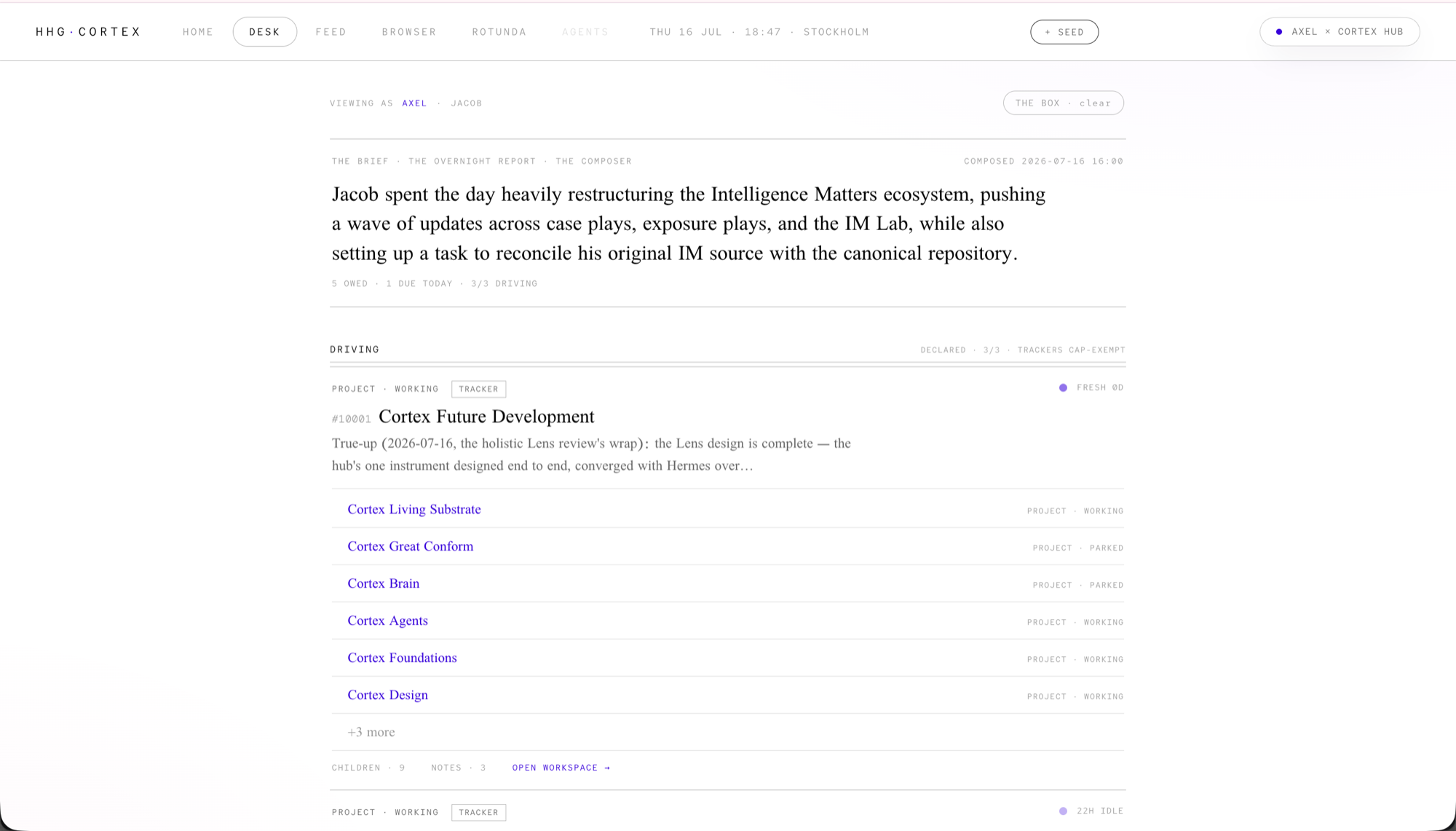
The desk · the brief composes itself — what's owed, what you're driving · specimen, live system
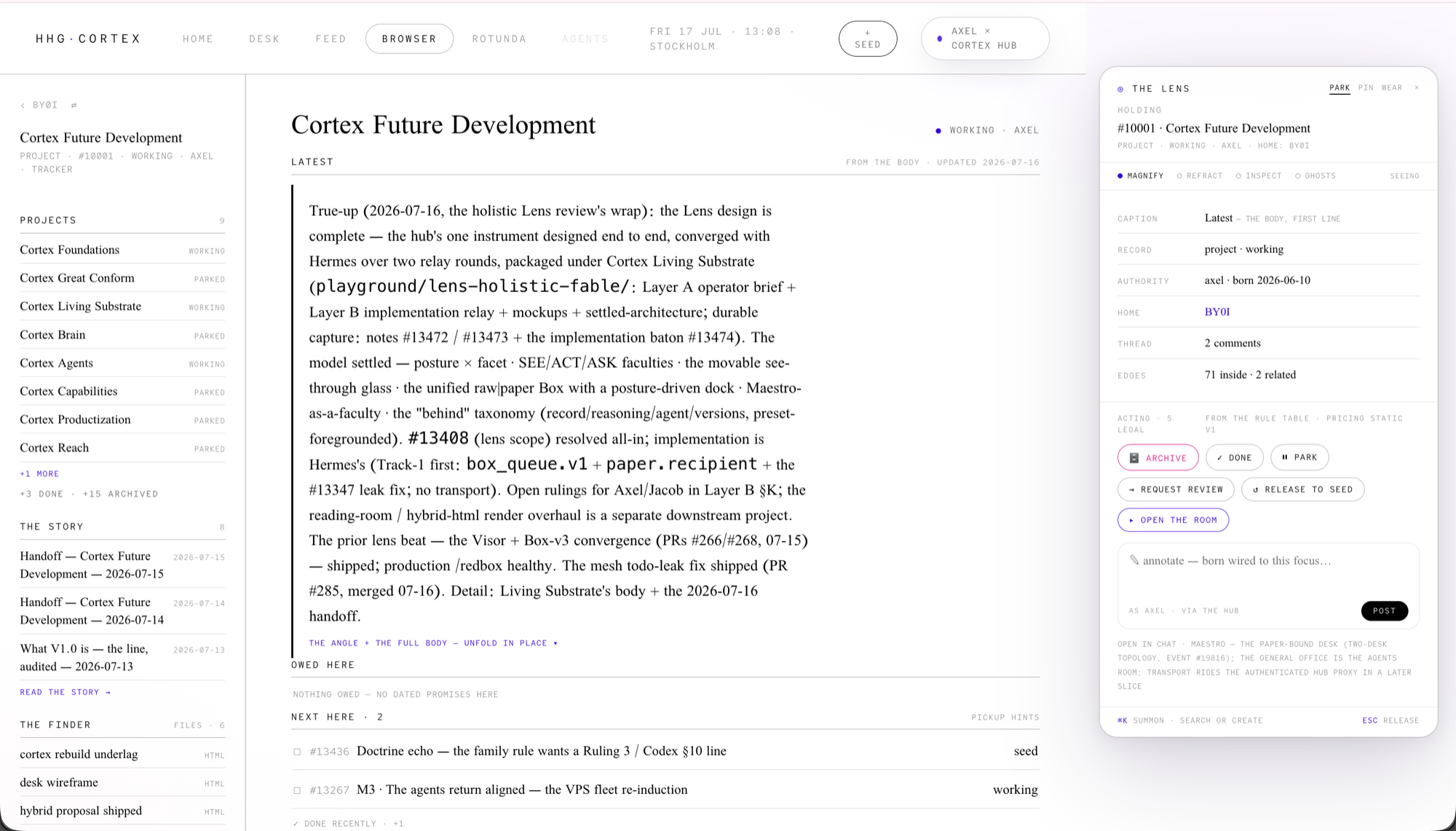
A workspace · the cortex building itself, the lens holding it · specimen, live system
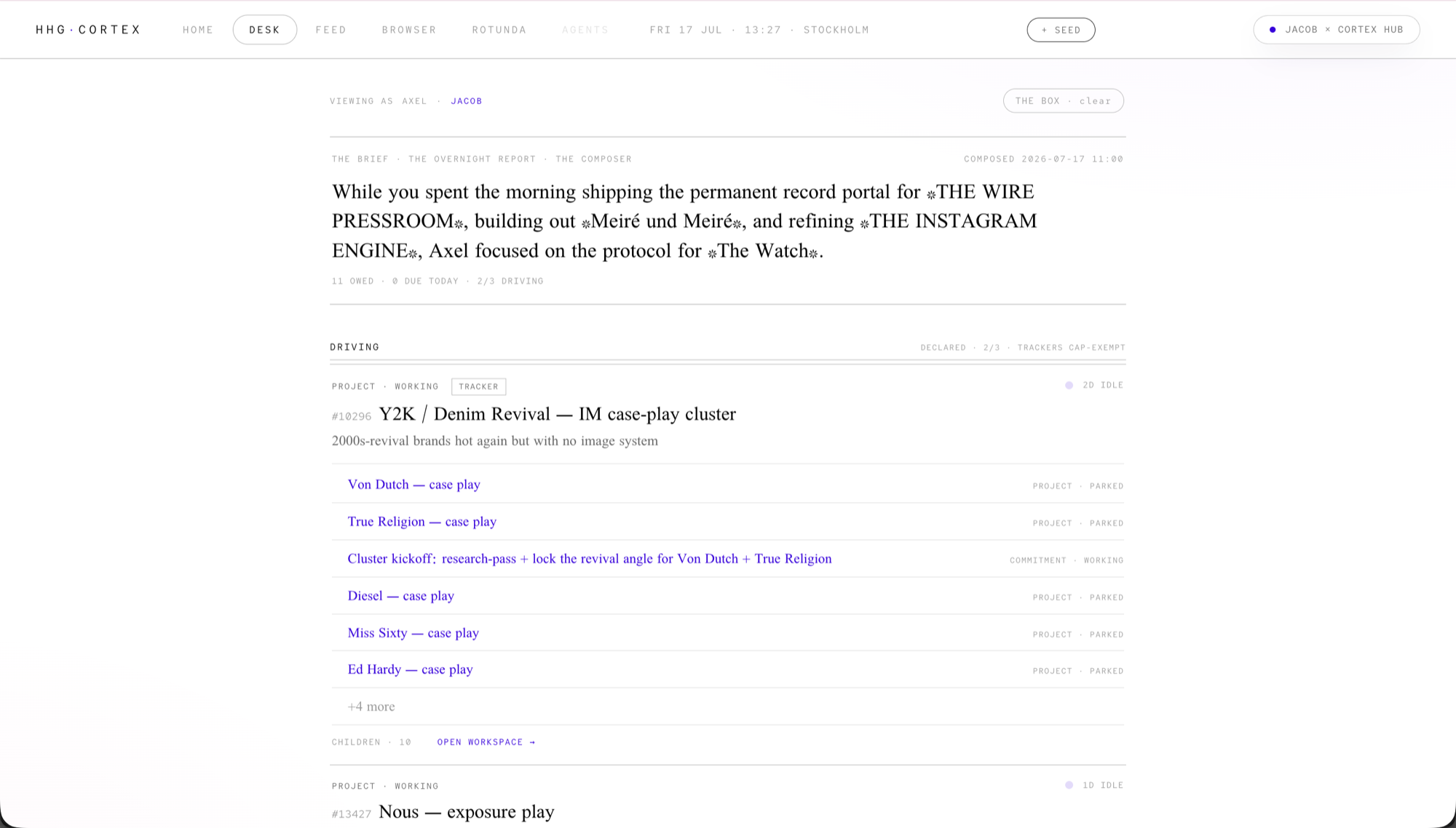
The other desk · two operators, one brain — the same system, the other chair · specimen, live system
You don't start it, and you don't shut it down. You visit it — a colleague who never left the room.
05_THE ANATOMY
Eight organs, every cortex. What fills each is entirely yours. This is ours, named.
01 · SubstrateThree stores, one truth
Documents · live state · relationships — each in the home it's best at, joined the moment a screen is drawn.
02 · The one doorEvery change, governed
One write-path for humans and machines alike. The store itself refuses a change that arrives without its reason.
03 · The journalEverything, forever
An append-only record of every act — attributed, timestamped. Briefs compose from the record, never from memory.
04 · The brainRecall + connection
Semantic search and a governed graph inside the store — related work finds itself overnight; a human confirms.
05 · SurfacesOne window
A hub of rooms — the desk, the browser, the workspace, the reading room — one view over all three stores.
06 · The agentsThe acting layer
An always-on conductor, background composers, a mechanical gatekeeper — all of it propose-only.
07 · The contractsThe law, rendered
Machine-readable contracts govern creation, containers, documents, publishing. The rules are read, not remembered.
08 · MultiplayerTwo people, one brain
Presence, handoffs, derived claims. Nobody writes a status report; the record composes it.
COMPOSED FROM THE RECORD · AS OF 2026-07-17
The store3,485 typed entities · 20,530 journaled events — every one attributed, as of 2026-07-17
The territory~40 statused surfaces · ten governing contracts · a registered agent roster
The operation2 operators · 4 ventures · 0 project managers. The record does the knowing-about-the-work.
It started as an experiment — how much of a company could we actually encode? The experiment never stopped.
06_THE LAW
An AI that acts needs a law. Ours is written, enforced — and it ships with the build.
Why this matters: every predecessor of this idea died a trust death — the wiki nobody updated, the dashboard nobody believed, the assistant that invented a name. A passive archive can afford to be a little wrong; a memory that acts cannot. The moment the system preps work, briefs you, and moves things on its own, a false statement stops being a stale page and becomes a wrong action.
So every acting system owes you an answer: what is it allowed to do without asking? Most of how a cortex is built is the careful answer to that one question. Ours is five written guarantees, held by mechanism, not by promise:
G1 · Nothing is vagueEverything is a typed thing with a state — a deck, a promise, a company. Nothing the system cannot name.
G2 · Nothing is anonymousEvery change passes one door, signed, recorded forever. Unattributed writes are refused.
G3 · Nothing is assertedWhat you see is composed from the record — never a hand-kept status page that drifted last month.
G4 · Nothing ships itselfTwo gates never open to the machine: sending anything out of the building, and making anything official.
G5 · Scale costs no trustAdd ten agents — every one signs its work, proposes instead of approving, and obeys the same law.
A memory that acts must never lie.
humans decide
agents propose
every write signed
from our operating doctrine · 2026
07_THE GTM CORTEX · A SCOPED BUILD
Every function gets a cortex. Revenue got one first.
A build doesn't have to start whole-company. Scope it to one function — and the function we've run longest on our own cortex is revenue: list building, enrichment, campaign staging, relationship memory, the full outbound lifecycle. The GTM Cortex is that scope, named: a cortex build with its aperture set to the sales motion — the showcase we operate every day, and a shape you can commission.
And it's one example, not the menu. Any function can be the aperture — support, finance, operations, delivery. Revenue is simply the one we can show running live.
It encodes
- ICP definitions that evolve with market learning
- Playbooks with conditional logic — not static documents
- Relationship memory across buying committees
- Signal interpretation calibrated to your definitions
It orchestrates
- CRM operations — the pipeline, kept true
- Enrichment — the data, on demand
- Outreach execution — drafted in your voice
- Research + personalization — prepped before you sit down
The GTM Engineer brought the tools. The GTM Cortex brings the brain.
● in production on our own pipeline
scope: the revenue motion → grows to the company
The GTM Cortex · ATP · 2026
read the dispatch → r&d
08_THE ENGAGEMENT
Bespoke · scoped per engagement · no two are alike.
We don't hand you a copy. We build you a brain. A build does not start with our system — it starts with your company. We've built one before, ours, so we know the architecture and what holds. But your cortex isn't ours with your logo on it: it encodes your operation. That's why a build begins with real immersion, not a questionnaire. The understanding is the hard part. The understanding is the product.
S01 · ImmerseWe learn your company
Strategy work, shadowing, interviews. We earn a real picture of how the operation actually runs — not how the org chart says it does.
S02 · BuildWe encode the brain
Your decisions, voice, memory and relationships become a working system — wired to the tools you already use.
S03 · OperateWe maintain it · you run it
Your team trained to operate it; we keep it sharp on an ongoing basis. A cortex is a living system, not a delivery.
The line that makes this a Build: maintenance. If the upkeep is ours — the keeping-sharp, the keeping-true — it is a Build. A capability handed over and left with your team — that's the workshop track.
09_START HERE
Not a menu. A conversation. A small number of engagements at a time.
The conversation
For the company whose intelligence is its edge.
Write to us. The draft below is ready — one blank to fill. A reply within two days; a call within the week.
▸ open the draft
The fit check
Thirty minutes. Free. Not free consulting.
We figure out if there's a fit and which track makes sense to start with. No charge, no scoping work — a straight answer. If it's not a fit, we say so and point you somewhere useful.
▸ book the call
[ BYOI ] · BUILD · the deep end · Haegg & Haegg Group · 2026
We built one before this was a category.